Key Takeaways
- Delivery riders may use platform earnings statements and bank-in records to support income assessment.
- Licensed moneylenders still need to assess your income, documents, borrowing record, and repayment ability.
- Approval is not automatic, even if you have regular platform earnings.
- Borrowing limits depend on your income and residency status, not the platform you work with.
- A licensed moneylender must meet you in person at its approved place of business before granting a loan.
- Interest is capped at 4% per month on the outstanding principal.
- Before borrowing, check whether the repayment fits your real weekly or monthly cash flow.
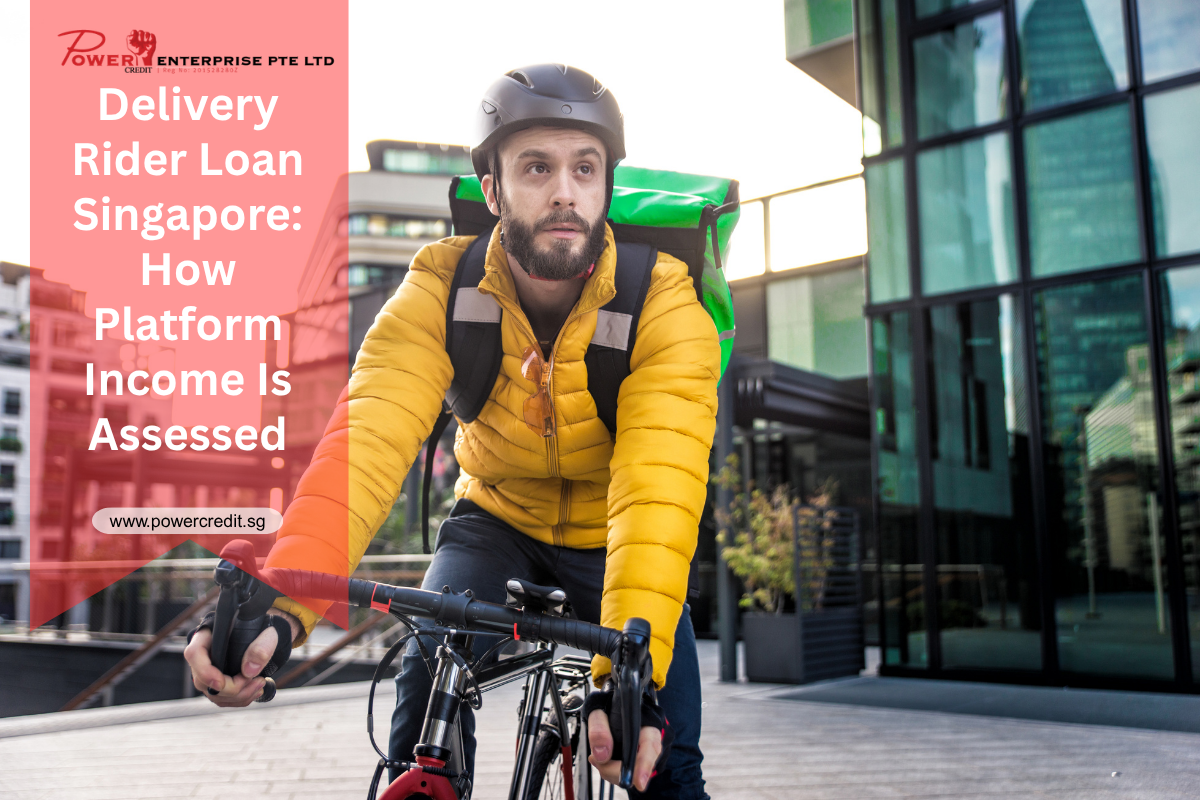
Delivery rider income does not always look like a normal monthly pay slip.
Some weeks are busy. Some weeks are quieter. Weather, incentives, bike repairs, delivery demand, and your own riding schedule can all affect how much lands in your account.
That does not mean your income is not real. It means your application may need to be assessed using the right supporting documents.
This guide explains how a delivery rider loan in Singapore may be assessed, what income proof may help, what borrowing limits apply, and what to check before signing any loan contract.
Mention of delivery platforms in this article is for income-document examples only. This article is not affiliated with or endorsed by any delivery platform.
First, Check Whether Borrowing Is the Right Step
A repair bill, phone replacement, medical cost, or slow earning week can create pressure quickly.
But before applying for a loan, pause and ask whether borrowing is the right solution.
Can the repair shop offer instalments?
Can you delay part of the expense?
Can you borrow a smaller amount?
Can you cover the gap from your next payout without taking a loan?
Can you repay the loan without affecting fuel, food, rent, family commitments, or platform-related costs?
You may also want to check your loan eligibility in Singapore before applying, so you understand what may affect your application.
A loan can help with timing. It does not remove the need to repay. The safer approach is to borrow only what you need and only what you can reasonably repay.
Why Delivery Rider Income May Need Extra Explanation
Many traditional loan assessments are built around fixed monthly salaries.
A salaried employee usually has a pay slip showing the same employer, the same pay cycle, and a fairly predictable monthly amount.
Delivery riders may not have that.
Your income may come from platform payouts, weekly transfers, incentives, peak-hour bonuses, or multiple delivery platforms. One week may be stronger than another. One month may look lower if you took time off, had fewer shifts, or had vehicle issues.
That is why the documents matter.
A lender cannot assess repayment ability based only on a claim. The lender needs records that show your earning pattern clearly.
For riders, the question is usually not only, “Do you have a pay slip?”
The better question is, “Can your income pattern be shown clearly enough for assessment?”
What Income Proof May Help a Delivery Rider?
You do not always need a traditional pay slip to show income.
Depending on your situation, the following documents may help support your application.
| Document Type | What It Shows | Why It Helps |
|---|---|---|
| Platform earnings statements | Your delivery earnings over time | Shows payout pattern, trip activity, and consistency |
| Bank statements | Deposits from delivery platforms | Shows income actually entering your bank account |
| CPF contribution records, if any | CPF activity or voluntary contributions | Adds another supporting record if available |
| Income tax notice, if available | Declared annual income | Helps show longer-term income |
| Platform account history | Length of time on the platform | Shows whether you have been active over time |
| Supporting documents | Address, identity, or other requested records | Helps complete the application file |
Different lenders may ask for different documents depending on the case.
If you are self-employed, ride across several platforms, or have irregular deposits, you may need more supporting records than a salaried borrower.
For a wider explanation of non-salaried income assessment, you can also read Power Credit’s guide on a personal loan for self-employed in Singapore.
How Platform Earnings May Be Assessed
A licensed moneylender needs to assess whether a borrower can repay the loan.
For a delivery rider, this may involve reviewing earning patterns across several weeks or months instead of relying on one fixed pay slip.
The lender may look at:
- How long you have been earning from delivery work
- Whether income is regular or occasional
- Whether platform statements match bank deposits
- Whether your recent income supports the repayment amount
- Whether you already have other outstanding loans
- Whether the loan amount requested is within the legal borrowing cap
A single strong week may not prove stable income. A single weaker week may also not tell the whole story.
What matters is the overall pattern.
If your earnings fluctuate, it is better to provide enough records for assessment instead of relying on one screenshot or one payout summary.
Delivery Rider Income vs Salaried Income
The assessment process may look different because the income records are different.
| Area | Salaried Employee | Delivery Rider |
|---|---|---|
| Main income proof | Pay slip, CPF statement, employment letter | Platform earnings statements and bank-in records |
| Income pattern | Usually monthly and fixed | May vary weekly or monthly |
| Work proof | Employer records | Platform account activity and payout history |
| Assessment focus | Monthly salary and existing obligations | Average income pattern, deposit rhythm, and repayment ability |
| Extra documents | Usually limited if records are clear | May need more months of bank statements or platform statements |
This does not mean one type of borrower is automatically better than the other.
It means the application should be supported by the right documents.
If your need is general borrowing, you may also want to compare how a personal loan in Singapore works. If your need is short-term and linked to your next payout or salary cycle, you can also read about how a payday loan works before deciding.
When a Loan May Help With a Rider Cash Flow Gap
Some rider expenses are directly tied to earning ability.
For example:
- Bike repair
- Tyre replacement
- Phone replacement
- Medical cost after a minor accident
- Temporary income gap from time off the road
- Family expense that arrives before your next payout
In these situations, the issue is often timing.
The cost appears before the next few payouts arrive. A loan may help bridge that gap, but only if the repayment is realistic.
Do not borrow based only on the amount available.
Borrow based on the amount needed and the amount you can repay.
For example, if the actual repair gap is $600, taking a much larger loan may feel safer at first. But a larger loan also means a larger repayment commitment.
The aim is not to borrow the maximum. The aim is to solve the specific gap without creating another problem later.
If you prefer fixed repayments over a longer repayment period, you may also want to understand how a monthly installment loan works before deciding.
Similar Issues Faced by Platform Drivers
Delivery riders are not the only platform workers with irregular income.
Private-hire drivers and taxi drivers can also face income gaps when vehicle repairs, rental costs, medical issues, or time off the road affect their earnings.
If you want to compare a similar case, read Power Credit’s guide on Grab driver loan Singapore or the service page for a PHV and taxi driver loan.
The main principle is the same: the loan should be sized around the real gap and assessed against realistic repayment ability.
What Can Delay or Affect Approval?
A delivery rider loan application may take longer if the documents are unclear or incomplete.
Common issues include:
- Platform screenshots that do not show dates clearly
- Bank statements that do not match the payout records
- Income that cannot be verified clearly
- Expired identity or pass documents
- Address details that are outdated
- Existing borrowing that is already near the legal cap
- A requested amount that does not match repayment ability
This is why preparation matters.
Before applying, gather a few months of platform statements and bank records if possible. Make sure your documents are readable and current.
If your income changed recently, explain why. For example, you may have taken time off for repairs, family matters, health reasons, or platform changes.
A clear explanation does not guarantee approval, but it can help the lender understand the file properly.
Face-to-Face Verification Is Still Required
Even if your enquiry starts online, a licensed moneylender must meet you in person at its approved place of business before granting a loan.
This step is required for identity verification and contract explanation.
A fully online loan transaction from a licensed moneylender is not allowed.
If someone says the whole loan can be completed over WhatsApp, Telegram, SMS, social media, or email without meeting in person, be careful.
Borrowing Caps for Delivery Riders
Delivery riders follow the same unsecured borrowing caps as other individual borrowers.
The limit is based on annual income and residency status. It is not based on which delivery platform you work with.
These limits apply across all licensed moneylenders combined.
| Borrower Profile | Maximum Unsecured Borrowing |
|---|---|
| Singapore Citizen or PR earning less than $10,000 a year | $3,000 |
| Singapore Citizen or PR earning at least $10,000 and less than $20,000 a year | $3,000 |
| Singapore Citizen or PR earning at least $20,000 a year | Up to 6 times monthly income |
| Foreigner residing in Singapore earning less than $10,000 a year | $500 |
| Foreigner residing in Singapore earning at least $10,000 and less than $20,000 a year | $3,000 |
| Foreigner residing in Singapore earning at least $20,000 a year | Up to 6 times monthly income |
These are maximum legal limits. They are not guaranteed approval amounts.
A lender may approve less after reviewing your income, documents, existing obligations, and repayment ability.
Your borrowing record may also be reflected in your licensed moneylender credit record. To understand how that works, read Power Credit’s guide on MLCB vs CBS Singapore.
Fees and Interest to Check Before Signing
Before signing any loan contract, check the cost carefully.
Licensed moneylenders in Singapore are subject to legal limits.
| Cost Type | Limit |
|---|---|
| Interest | Up to 4% per month |
| Late interest | Up to 4% per month on the overdue amount only |
| Admin fee | Up to 10% of the loan principal when the loan is granted |
| Late payment fee | Up to $60 for each month of late repayment |
| Court-ordered legal costs | Only if ordered by the court for a successful recovery claim |
| Total charges | Interest, late interest, admin fee, and late fees cannot exceed the loan principal |
Power Credit’s Notes to Borrowers explain the key rules borrowers should understand before taking up a loan.
Do not sign until you understand:
- The loan principal
- The admin fee
- The amount you will receive
- The repayment schedule
- The interest rate
- The late charges
- What happens if you miss payment
If anything is unclear, ask the lender to explain before signing.
Warning Signs to Avoid
A licensed loan should not feel rushed, secretive, or unclear.
Be careful if someone:
- Contacts you first by SMS, WhatsApp, phone call, or social media to offer a loan
- Says approval is guaranteed
- Says no documents or checks are needed
- Says the whole loan can be completed fully online
- Asks you to transfer money before disbursement
- Asks for your Singpass ID, password, or OTP
- Asks to keep your NRIC, work pass, ATM card, or bank card
- Asks you to sign a blank or incomplete contract
- Refuses to explain the repayment schedule clearly
If anything feels wrong, pause before sharing personal details or signing any document.
The Ugly Truth About Borrowing During a Slow Patch
The ugly truth is that a loan cannot fix a shrinking earning pattern.
If your delivery income has dropped for several weeks because of fewer orders, platform changes, health issues, or fewer riding hours, a loan may only buy time.
It does not solve the reason your income dropped.
That is why the loan amount matters.
Borrow for the actual gap, not a round number that feels safer. If the issue is a repair cost, size the loan around the repair and the realistic income gap while you are off the road.
Then check the repayment against your normal earning pattern, not your best week.
Before signing, write down three numbers:
How much you will receive
How much you must repay each month
How much you usually earn after platform-related expenses
If the repayment only works during a strong week, it may be too tight.
A smaller, well-sized loan is usually safer than taking a larger amount just because it is available.
How to Prepare Before Applying
You cannot control every part of the assessment, but you can reduce avoidable delays.
Before applying, prepare:
- Your NRIC or valid identity document
- Recent platform earnings statements
- Recent bank statements showing platform deposits
- Proof of address
- CPF records or income tax notice, if available
- A clear loan amount and reason
- A repayment plan based on normal income, not your best week
You should also check that the lender is listed on the official Registry of Moneylenders before sharing personal information or visiting the office.
Frequently Asked Questions
Can a delivery rider apply for a licensed moneylender loan?
Yes, a delivery rider may apply. The lender will still need to assess your income, documents, existing obligations, credit record, and repayment ability.
Approval is not automatic.
Do I need CPF contributions to qualify?
CPF contributions may help if you have them, but they may not be the only way to support your application.
Platform earnings statements, bank-in records, income tax documents, and other accepted proof may also be reviewed.
Ask the lender what documents apply to your situation.
Which platform earnings can be used as proof?
Earnings records from delivery platforms may help if they clearly show your income pattern, payout dates, and activity over time.
The platform name is less important than whether the statement is clear, current, and matches your bank records.
How much can a delivery rider borrow in Singapore?
The maximum unsecured borrowing amount depends on annual income and residency status.
For Singapore Citizens and PRs earning at least $20,000 a year, the legal cap is up to 6 times monthly income across all licensed moneylenders combined. For lower income tiers, fixed caps apply.
This is a legal maximum, not a guaranteed approval amount.
Will the loan affect my MLCB record?
A loan from a licensed moneylender may be recorded with the Moneylenders Credit Bureau.
Your MLCB record helps licensed moneylenders assess existing borrowing and repayment behavior. Repaying on time helps keep your record in better standing.
Can I apply if I only started delivery work recently?
You may apply, but a shorter track record may give the lender less information to assess.
If you only started recently, gather whatever records you have, including platform statements, bank deposits, and any other income proof.
Can the whole loan be done online?
No. A licensed moneylender must meet you in person at its approved place of business before granting the loan.
Be careful if someone says the entire process can be completed online without face-to-face verification.
Before You Decide
Delivery rider income may change from week to week, but that does not mean it cannot be assessed.
The key is to show your income clearly, understand your borrowing limit, check the lender, and make sure the repayment fits your actual cash flow.
Do not borrow based on pressure. Do not borrow based on the maximum amount available. Borrow only after you understand the contract, the repayment schedule, and the total cost.
If you decide to proceed, you can start a secure enquiry, subject to assessment, and review your loan terms carefully before signing anything.