Key Takeaways
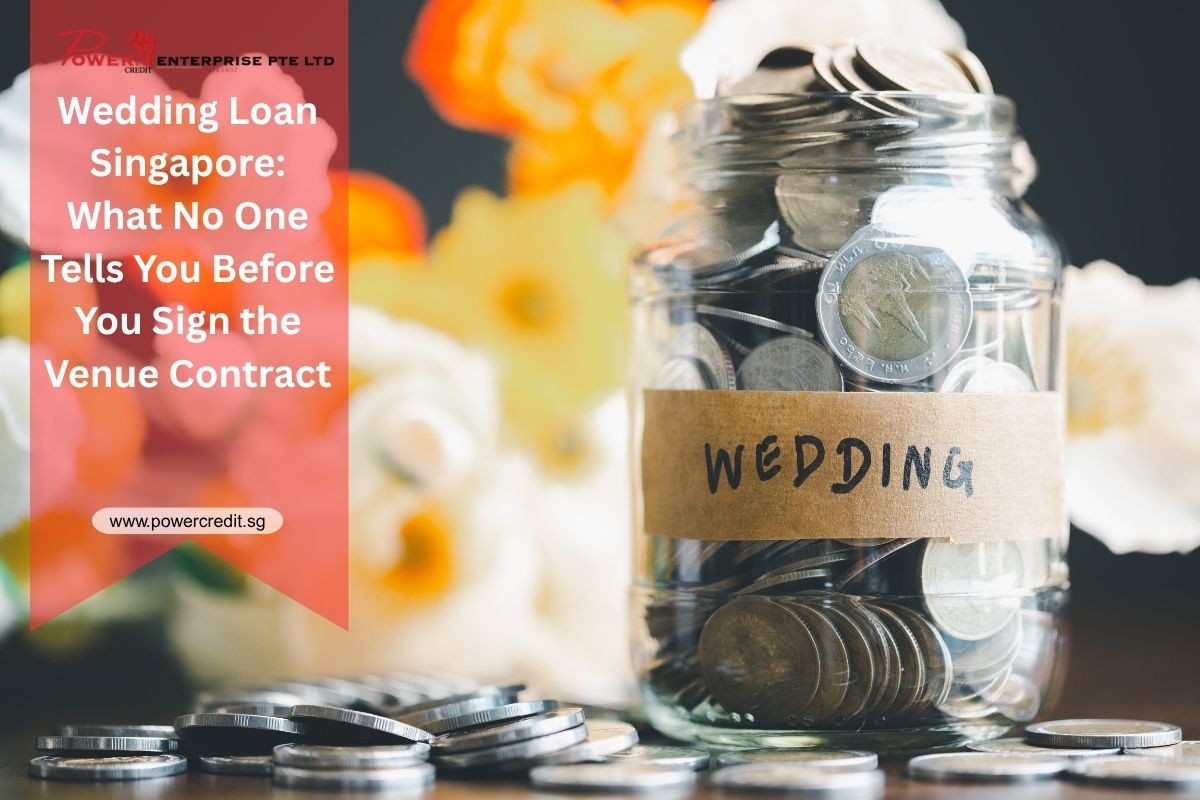
- The average cost of a wedding in Singapore in 2026 is between S$30,000 and S$60,000 for a banquet of 200 to 300 guests. Hotel ballroom weddings regularly exceed S$80,000.
- Venue deposits are typically 10% to 20% of the total package cost, due at signing, often 12 to 18 months before the wedding date. This is the expense that catches most couples off guard.
- A wedding loan from a licensed moneylender is capped by law at 4% interest per month on the reducing balance. The admin fee is capped at 10% of the principal. Total charges cannot exceed 100% of the original loan amount.
- Wedding loans from licensed moneylenders do not affect your CBS bank credit score. Activity is recorded on the MLCB only, which is a separate system.
- Couples who split the loan between two borrowers and two income assessments can access a higher combined borrowing limit.
- Power Credit has been approving wedding loans in Singapore since 2007. Verifiable on the MinLaw Registry.
It is a Wednesday evening. The platform payout for last week came in at S$1,840. Not a bad week. You and your partner have been setting aside S$400 a month from whatever the combined income adds up to after fuel, maintenance, and rent.
You came back from the hotel venue presentation together. The function room was the right size. The food tasting went well. The package included the solemnization space and the bridal suite. The coordinator handed over the folder with the full quote at the end. S$48,000.
The deposit to hold the date is S$7,500, due within 14 days. The wedding is 16 months away.
You have been saving for eight months. Combined savings right now: S$5,200. At the current rate, you will have roughly S$11,800 by the wedding date, before photography, before the gown, before ang pow envelopes, before anything.
The spreadsheet does not work. And the coordinator mentioned two other couples have enquired about the same Saturday.
Grab income is irregular by design. Surge weeks and slow weeks do not follow a calendar you can plan a wedding budget around. Most banks know this and their loan assessment process reflects it. This guide is written for couples where at least one partner earns through platform driving, delivery, freelance work, or commission, and who need a realistic picture of how wedding financing actually works for that income profile.
How Much Does a Wedding in Singapore Actually Cost in 2026?
Before looking at any financing option, it helps to have a realistic breakdown of where the money goes.
Venue and food (the largest single cost)
A hotel banquet for 200 guests in Singapore in 2026 typically runs between S$28,000 and S$50,000 depending on the property, the day of the week, and the menu tier. Weekend evening bookings at four-star and five-star hotels sit at the higher end. Weekday or lunch bookings, and community club or restaurant venues, bring the cost down considerably.
Gown, suit, and wedding attire
A bridal gown package including alterations, bridesmaids’ dresses, and a suit for the groom ranges from S$2,500 to S$8,000 depending on whether you purchase or rent, and whether the designer is local or international.
Photography and videography
A wedding photography package covering the actual day runs from S$2,500 to S$6,000 for reputable local studios. Adding a videography team adds S$2,000 to S$4,000. Pre-wedding photography shoots are typically priced separately at S$800 to S$3,000.
Florals, décor, and solemnisation
Full floral and décor packages for the ceremony and banquet range from S$1,500 to S$5,000. A ROM or solemnization ceremony, if held separately, adds S$800 to S$2,500.
Other standard items
Rings (S$1,500 to S$5,000 combined), invitations and favours (S$500 to S$1,500), wedding car (S$500 to S$1,200), makeup and hair for the couple (S$800 to S$1,800).
Realistic total range
For a mid-tier Singapore wedding with 200 to 250 guests, a realistic total is S$35,000 to S$55,000. This figure excludes the honeymoon. Every single line item in a wedding budget trends higher than the original quote. Build that in from the start.
The Deposit Problem: Why Timing Is the Real Challenge
Most couples budget for the total cost. Few plans specifically for the deposit timing.
Hotel venues in Singapore require a deposit at contract signing, typically between 10% and 20% of the package value. On a S$45,000 package, that is S$4,500 to S$9,000 due before the couple has had time to save. And the deposit is almost always non-refundable or subject to strict cancellation penalties.
The photography studio requires a booking deposit. The gown boutique requires a deposit. The solemnization venue may require a deposit. The florals supplier often requires a deposit. These deposits do not all fall on the same date, but they all fall 6 to 18 months before the wedding, well before any ang pow income arrives to help offset costs.
This is the structural cash-flow problem most couples face. Not the total cost. The front-loaded nature of how weddings are paid for in Singapore.
For a Grab or Gojek driver, this timing problem is sharper than it is for a salaried employee. A salaried partner can point to next month’s payslip. Platform income does not work like that. A slow week the month the deposit is due is not a planning failure. It is just how the platform calendar works.
A wedding loan solves a timing problem. It bridges the gap between when deposits are due and when income, savings, or ang pow contributions can cover them.
Wedding Loan Options in Singapore: What Is Actually Available
There are three realistic financing options for Singapore couples in 2026.
Option 1: Bank personal loan
Banks offer personal loans that can be used for wedding expenses. Interest rates start from approximately 3.5% per annum (EIR of around 6 to 8%). Approval typically takes 3 to 7 working days. Banks require a minimum annual income of S$20,000 to S$30,000 depending on the institution, a good CBS credit score, and standard employment documentation.
The limitation for platform workers: banks assess income through payslips and CPF contributions. Grab and Gojek payouts are not salary income. A driver earning S$4,500 a month from the platform may not be able to demonstrate that income in a format a bank accepts. A low CBS score or thin credit history compounds the problem. Bank rejection is common for this income profile.
Option 2: Credit card instalment plan or balance transfer
Some banks offer 0% instalment plans for wedding-related merchants or balance transfer promotions for 6 to 12 months. These are useful for specific vendors who are participating merchant partners. They do not cover all wedding costs, and the 0% period is temporary. After the promotional window closes, standard credit card rates apply, which are among the highest consumer rates in Singapore.
Option 3: Licensed moneylender wedding loan
A licensed moneylender wedding loan is a personal loan used specifically for wedding expenses. The key difference from a bank loan is the assessment framework. Licensed moneylenders check the MLCB and assess current income and repayment capacity, rather than CBS score and multi-year credit history. For platform workers, freelancers, and commission-based earners, this matters. Bank statements showing consistent incoming transfers from Grab, Gojek, or Tada are readable evidence of income at a licensed moneylender. A Notice of Assessment showing platform earnings is accepted documentation.
Interest is capped by law at 4% per month on the reducing balance. Approval can happen on the same day for applicants with complete documents. The loan does not affect your CBS credit score.
How a Licensed Moneylender Wedding Loan Works at Power Credit
Power Credit’s wedding loan is a structured personal loan with a fixed monthly repayment schedule. Here is how the process works from application to cash in hand.
Step 1: Apply online via Singpass MyInfo
Go to solution.eform.sg/powercredit/myinfo. The application takes 3 minutes. Singpass MyInfo pulls your identity and income data automatically. You receive an in-principle response before you need to take time off the road to visit the office.
Step 2: Loan assessment
Our loan officers review your current income, MLCB outstanding balance, and repayment capacity. For platform drivers, this means your Grab or Gojek payout history shown in bank statements, and your most recent Notice of Assessment. We assess your ability to service the loan across the full repayment term. This is a requirement under the Moneylenders Act. Most assessments during office hours receive a response the same day.
Step 3: In-person verification at Tanjong Pagar
Under MinLaw regulations, all licensed moneylender loan contracts must be signed in person at the registered office. We are at 1 Tras Link, #01-11 Orchid Hotel. That is 100 metres from Tanjong Pagar MRT Exit A. Every line of your contract is explained before you sign. The principal, interest calculation, admin fee, monthly repayment, and total repayable amount. Nothing is confirmed until you understand and agree to every term.
Step 4: Funds disbursed
Once you sign, funds are released the same day. Cash or bank transfer, depending on your preference.
You leave knowing exactly what you owe, when each payment falls, and what the total cost is. No surprises appear after disbursement.
The Exact Cost: What a Wedding Loan From a Licensed Moneylender Costs
The Moneylenders Act caps three things precisely. There are no exceptions for any licensed moneylender in Singapore.
Interest: 4% per month on the reducing balance
The reducing balance means the 4% applies to the outstanding principal only. As you repay the loan each month, the principal falls, and so does the interest charge. Month one has the highest interest. The final month has the lowest.
Admin fee: 10% of the principal, charged once
The admin fee is deducted from the disbursement. On a S$15,000 loan, the admin fee is S$1,500. You receive S$13,500 in hand. The fee is not charged again at any point during the loan.
Total charges cap: cannot exceed 100% of the original principal
All interest and all fees across the entire loan life cannot exceed the original amount you borrowed. If you borrow S$15,000, the maximum total in charges is S$15,000. The debt has a legal ceiling.
Worked example: S$15,000 wedding loan over 18 months
Item | Amount |
|---|---|
Loan principal | S$15,000 |
Admin fee (10%, deducted upfront) | S$1,500 |
Amount received in hand | S$13,500 |
Monthly repayment | S$1,185 (approx.) |
Month 1 interest | S$600 |
Month 9 interest | S$384 |
Month 18 interest | S$46 |
Total interest over 18 months | S$6,328 (approx.) |
Total cost (interest + admin fee) | S$7,828 (approx.) |
Late fee if a payment is missed | S$60 maximum per month |
These figures are indicative. Your actual offer is confirmed at the office. The total charges cap means the most you can ever owe in fees and interest on S$15,000 is S$15,000. From day one, the ceiling is fixed.
For a platform driver earning S$3,500 to S$4,500 per month, a monthly repayment of S$1,185 represents roughly 26% to 34% of monthly income. That is within a serviceable range, but it should be stress-tested against a slow month, not an average month. Power Credit’s loan officers will run this calculation with you at the time of application.
How Couples Can Borrow More: The Two-Borrower Approach
MinLaw borrowing limits are assessed per individual borrower. For Singapore citizens and PRs earning S$20,000 or above annually, the limit is up to 6 times monthly income across all licensed moneylenders combined.
For a couple where one partner earns S$4,000 per month as a platform driver, the individual ceiling is S$24,000, assuming no existing moneylender debt. If the second partner also earns S$4,000 per month with no existing moneylender debt, each partner has a separate S$24,000 ceiling based on their own income assessment.
This does not mean both partners must borrow. It means the couple has more flexibility in structuring how the loan is taken and repaid. In some cases, splitting the total across two borrowers, each taking a smaller loan within their individual limits, results in lower individual repayments and greater flexibility in managing cash flow across the months leading up to the wedding.
Discuss this structure with Power Credit’s loan officers at the time of your application. They will assess both individuals’ income and MLCB records and confirm the most appropriate arrangement.
What a Wedding Loan Does Not Affect
Two things most couples worry about that a licensed moneylender wedding loan does not touch.
Your CBS bank credit score
Licensed moneylenders report to the MLCB, not the CBS. Your bank credit score is entirely unaffected by a loan from Power Credit. This means your HDB loan application, your future bank credit card applications, and any other bank product assessments remain based on your CBS record alone.
If you want a full breakdown of how MLCB and CBS work as separate systems, read the complete guide: MLCB vs CBS Singapore: What Every Borrower Must Know Before Taking a Loan in 2026.
Your HDB BTO or resale flat eligibility
HDB loan assessments use your CBS record and MAS-regulated financial data. MLCB data is not part of HDB’s own loan assessment process. A wedding loan from a licensed moneylender does not appear in the documentation that HDB reviews for its concessionary loan or flat eligibility check.
What does affect your HDB eligibility is your Total Debt Servicing Ratio (TDSR). Monthly loan repayments, including any licensed moneylender loan repayments, form part of your total monthly debt obligations. If you are planning both a wedding loan and a home purchase within the same period, factor your monthly repayment amount into your TDSR calculation before committing to a loan amount.
Red Flags to Avoid When Looking for a Wedding Loan in Singapore
The urgency of a deposit deadline makes borrowers vulnerable to making rushed decisions. Before signing anything with any lender, run through this checklist.
Check the MinLaw Registry first
Every licensed moneylender in Singapore appears on the registry at rom.mlaw.gov.sg. Search the lender’s name or licence number. If they do not appear, they are not licensed. Do not proceed.
No legitimate moneylender contacts you unsolicited
MinLaw prohibits licensed moneylenders from advertising via phone calls, SMS, WhatsApp, or Telegram. If someone messaged you offering a wedding loan, they are not a licensed moneylender.
Upfront fees before disbursement are illegal
Licensed moneylenders collect the admin fee as a deduction from the loan disbursement, not as a separate upfront payment before you receive any funds. A request for any payment before the loan is released is a scam.
In-person signing is not optional
Any lender offering to disburse funds without a face-to-face meeting at their registered office is not operating within the licensed framework. The in-person meeting is where your contract is explained and signed. It is a MinLaw requirement, not an inconvenience.
Planning Your Wedding Loan: What to Borrow and What to Leave for Savings
Not every wedding expense needs to come from a loan. A useful approach is to separate the expenses by timing and by certainty.
Deposits cover venue, photography, and gown. These are time-critical and fall early. They are the right candidates for a loan because the cost is known, the deadline is fixed, and the alternative is losing the booking.
Expenses that fall closer to the wedding date, such as décor, favours, makeup, and honeymoon costs, can often be covered by savings that accumulate across the 12 to 18 months between booking and the wedding. For a platform driver setting aside even S$300 per month across 14 months, that is S$4,200 toward later-stage costs.
Frequently Asked Questions About Wedding Loans in Singapore
Can I use a personal loan from a licensed moneylender for my wedding?
Yes. A personal loan from a licensed moneylender can be used for any personal expense, including wedding costs. There is no restriction on the purpose of the loan beyond the general requirement that you demonstrate repayment capacity. Power Credit’s wedding loan is a personal loan structured for this purpose.
How much can I borrow for a wedding loan?
For Singapore citizens and PRs earning S$20,000 or above annually, you can borrow up to 6 times your monthly income across all licensed moneylenders combined. For someone earning S$4,500 per month, the ceiling is S$27,000, assuming no existing moneylender debt. For couples where both partners apply, each partner’s limit is assessed individually based on their own income and MLCB record.
Does a wedding loan affect my HDB flat application?
A loan from a licensed moneylender does not appear on your CBS credit record and is not part of HDB’s standard flat eligibility review. However, your monthly loan repayment is a real financial obligation that affects your TDSR. If you are planning a flat purchase and a wedding within close timing, factor the repayment into your TDSR calculation before borrowing.
How quickly can I get the money?
Eligible applicants who apply online via Singpass MyInfo and complete in-person verification at our Tanjong Pagar office during office hours can receive funds the same day. The online application takes 3 minutes. Most assessments during office hours receive a response the same day. Bring your NRIC, recent payslips or Notice of Assessment, and 3 months of bank statements.
What if I have a low CBS credit score?
Power Credit assesses applications using the MLCB, your current income, and your repayment capacity, not your CBS score. A bank rejection because of a low CBS score does not affect your Power Credit application. If your MLCB record is clean and your income supports the repayment, a low CBS score is not a disqualifying factor.
Can I repay the loan early if ang pow contributions cover the balance?
Yes. Power Credit does not charge an early repayment penalty. If wedding gift contributions or savings allow you to settle the remaining balance ahead of schedule, interest stops accruing from the repayment date. Many couples plan for this, borrowing to cover deposits and early costs, then settling the balance partly or fully from ang pow income after the wedding.
Is a wedding loan different from a personal loan?
In legal and regulatory terms, they are the same product, a personal loan governed by the Moneylenders Act. The term “wedding loan” describes the intended use, not a distinct loan product category. The same interest caps, fee caps, borrowing limits, and MinLaw protections apply.
I drive for Grab and my income varies month to month. Can I still qualify?
Yes. Power Credit has been approving loans for platform workers and self-employed borrowers since 2007. We assess income using bank statements showing your platform payouts, not payslips. A consistent history of incoming Grab or Gojek transfers across 3 to 6 months of bank statements is accepted income evidence. Your loan officer will factor the variability into the repayment assessment so the monthly commitment is sized to your slower months, not only your peak weeks.
Apply at Power Credit: What to Bring
Power Credit has been helping Singaporeans finance their weddings since 2007. The costs are fixed by law before you sign a single document.
Here is what to bring to the office:
- Your NRIC (or passport and valid work pass for foreigners)
- Your last 3 to 6 months of bank statements showing income (platform payouts, salary transfers, or both)
- Your latest IRAS Notice of Assessment
- Your vendor quotes or a rough breakdown of the costs you need to cover (optional, but useful for sizing the loan correctly)
Apply online first at solution.eform.sg/powercredit/myinfo using your Singpass. It takes 3 minutes and gives you an in-principle response before the visit.
If you do not qualify for the amount you need, we will tell you before you make the trip.
The venue deposit is waiting. The date is not.
Apply online at powercredit.sg via Singpass MyInfo. It takes 3 minutes.
Call +65 6443 2940 during office hours.
Power Credit Enterprise Pte Ltd 1 Tras Link, #01-11 Orchid Hotel Singapore 078867
100 metres from Tanjong Pagar MRT Exit A
Monday to Friday: 11am to 7pm Saturday: 11am to 6pm Closed Sunday and Public Holidays