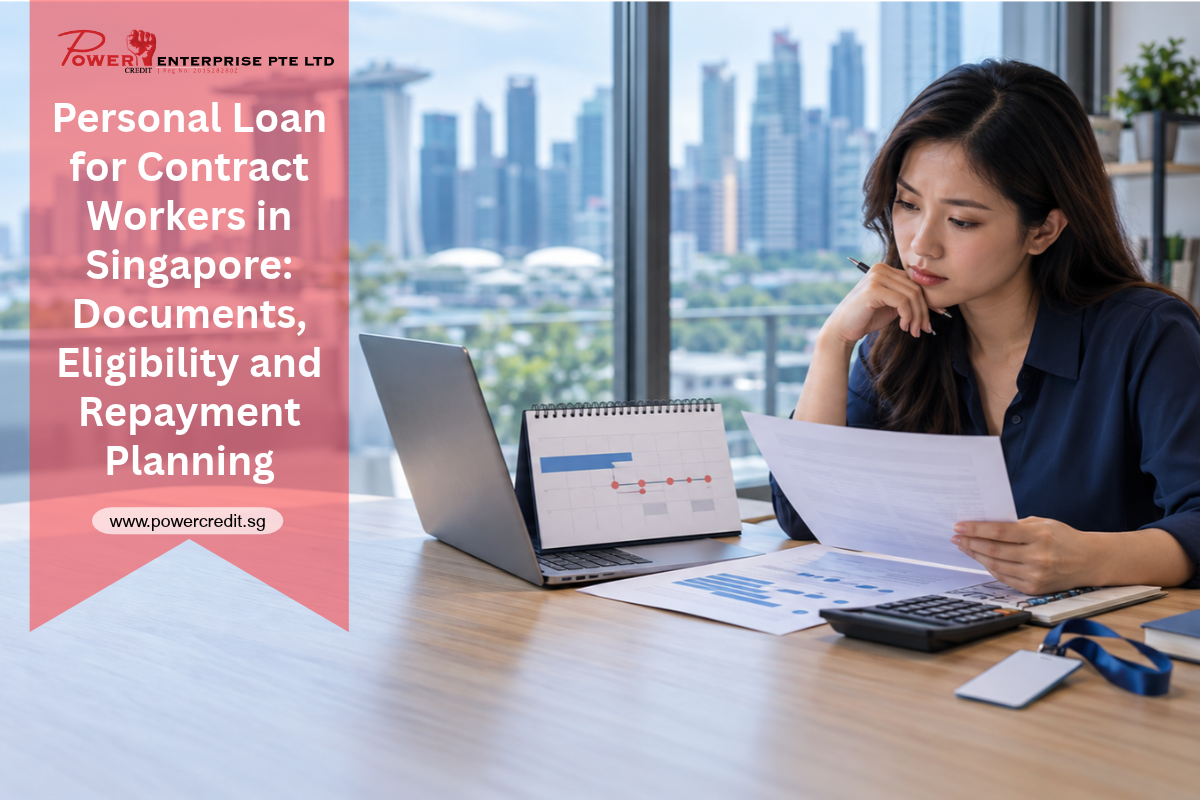
Fixed-term employment is common in project work, administration, technology, healthcare, construction, logistics and professional services. Some contracts last several months, while others run for one or two years with the possibility of renewal.
Although contract workers receive employment income, applying for financing can be different from applying as a permanent employee. A lender may need to consider not only your monthly salary but also how much time remains on your employment contract.
A personal loan for contract workers in Singapore may be available when the applicant can provide reliable income records and demonstrate that the proposed repayments are affordable.
However, approval is never guaranteed. The approved amount, interest rate and repayment period depend on individual assessment.
This guide explains what contract workers should prepare, how remaining contract duration may affect an application and how to choose a repayment schedule that does not depend on an uncertain renewal.
Key Takeaways
- Fixed-term and temporary employees may apply for personal loans in Singapore.
- Contract employment does not automatically result in approval or rejection.
- The lender may consider how long remains on your employment contract.
- Several months of payslips and bank salary credits can help establish income stability.
- Do not assume your employment contract will be renewed.
- Choose a repayment schedule that remains affordable before the current contract ends.
- Eligible Singapore citizens and permanent residents working under a contract of service may receive CPF contributions.
- Foreign applicants should ensure their work pass and employment contract remain valid.
- Statutory borrowing limits are maximum limits, not guaranteed approval amounts.
- All applications remain subject to verification, affordability assessment and approval.
Who Is Considered a Contract Worker?
A contract worker is an employee engaged for a defined period or project under a contract of service.
Common arrangements include:
- Six-month employment contract
- One-year renewable contract
- Project-based appointment
- Temporary administrative assignment
- Maternity-cover position
- Seasonal employment
- Agency placement
- Fixed-term professional appointment
- Contract-to-permanent role
- Short-term technical assignment
Singapore’s Ministry of Manpower states that the Employment Act does not distinguish between temporary, contract, daily-rated and tenured employees when determining its basic coverage. Employees under a contract of service—including fixed-term employees—are generally covered, subject to the applicable exclusions.
A contract employee is different from an independent contractor.
| Contract employee | Independent contractor |
|---|---|
| Works under a contract of service | Provides services under a contract for service |
| Usually receives wages from an employer | Usually invoices customers or clients |
| May receive payslips and CPF contributions | Generally manages their own business records |
| Works according to agreed employment terms | Controls how services are delivered |
| Treated as an employee | Usually treated as self-employed |
Applicants working independently should read Power Credit’s article about personal loans for self-employed individuals instead.
Can Contract Workers Get a Personal Loan in Singapore?
Yes, a contract worker may submit an application.
The lender may assess:
- Monthly basic salary
- Regular allowances
- Length of current employment
- Remaining contract duration
- Likelihood of continuing income
- Previous employment history
- Contract-renewal records
- Existing loans and repayments
- MLCB borrowing history
- Monthly household expenses
- Requested amount
- Proposed loan tenure
- Ability to repay before the contract expires
A fixed-term employee with consistent salary records and a manageable request may be easier to assess than an applicant whose employment ends shortly and has no confirmed source of income afterwards.
Every application must still be considered individually.
Does Contract Employment Reduce Your Approval Chances?
Contract employment alone does not decide the outcome.
A lender is more likely to focus on whether your income can be verified and whether it is expected to continue throughout the proposed repayment period.
Consider these two simplified examples:
| Applicant A | Applicant B |
|---|---|
| Twelve-month contract | Three-month temporary contract |
| Eight months remaining | Two weeks remaining |
| Six months of salary records | One partial payslip |
| Contract renewed previously | No renewal information |
| Modest loan request | Requests maximum possible amount |
| Limited existing debt | Several active repayments |
Applicant A may present a clearer income position, but this does not mean Applicant A is guaranteed approval or Applicant B will automatically be rejected.
The lender must consider the complete financial circumstances.
Why Does the Remaining Contract Period Matter?
A loan repayment schedule may continue for several months. If your employment contract ends before the loan is fully repaid, the lender must consider how later instalments will be funded.
Suppose:
- Your contract has three months remaining.
- The proposed loan tenure is nine months.
- No renewal has been confirmed.
- You have no other documented income.
The last six repayments would depend on income that is not yet established.
A more cautious solution might involve:
- Requesting a smaller amount
- Choosing a shorter affordable tenure
- Waiting for written renewal confirmation
- Providing evidence of another confirmed position
- Considering a payment plan instead of borrowing
- Postponing non-essential expenditure
A short tenure is not automatically better. It can produce instalments that are too high for your monthly cash flow. Both the instalment and the employment timeline must be considered.
What Documents Should Contract Workers Prepare?
Identification documents
Singapore citizens and permanent residents should prepare a valid NRIC and any other identification required.
Foreign applicants may need:
- Passport
- Valid work pass
- Employment contract
- Proof of Singapore residential address
- Recent payslips
- Salary-crediting bank statements
Current employment contract
The contract is one of the most important documents for a fixed-term employee.
It should show:
- Employer’s name
- Employee’s name
- Job title
- Employment start date
- Employment end date
- Basic salary
- Fixed allowances
- Salary period
- Working arrangements
- Notice period
- Renewal provisions, where applicable
MOM’s key-employment-terms guidance states that the duration of employment should be included when an employee is on a fixed-term contract.
Recent payslips
Prepare several recent payslips showing:
- Basic salary
- Allowances
- Overtime
- Incentives
- CPF deductions
- Other deductions
- Net salary
- Pay period
A partial first-month payslip may not accurately represent normal monthly income.
Bank statements
Bank statements can confirm that salary was received.
The lender may review:
- Salary-credit dates
- Employer payment references
- Net amount received
- Existing repayment deductions
- Regular expenses
- Other financial commitments
- Unexplained transfers
The salary credits should correspond reasonably with the payslips.
CPF contribution history
Eligible Singapore citizens and permanent residents working under a contract of service may receive CPF contributions.
CPF states that contribution obligations can apply to full-time, part-time, temporary and contract employees who meet the applicable requirements.
Foreign employees generally do not receive CPF contributions and should prepare alternative evidence of income.
Contract-renewal letter
If your contract has been renewed, provide:
- Current renewal letter
- Previous contract
- New contract period
- Updated salary terms
- Employer confirmation
An informal statement such as “my manager said it should be renewed” is not equivalent to written confirmation.
Previous employment records
A stable employment history can provide useful context, especially when your current contract started recently.
Relevant records may include:
- Previous contracts
- Previous payslips
- Earlier salary bank credits
- IRAS Notice of Assessment
- CPF contribution history
- Completion or termination letter
Proof of address
Prepare an accepted document such as a recent:
- Utility bill
- Telecommunications bill
- Bank statement
- Tenancy agreement
- Official government correspondence
What If Your Contract Is About to Expire?
An approaching expiry does not automatically prevent you from applying, but it introduces uncertainty.
Before applying, determine whether you have:
- A signed renewal
- A confirmed permanent role
- A signed contract with another employer
- Sufficient savings to cover repayments
- Another reliable and documented income source
- A repayment plan ending before the contract expires
Do not describe a possible renewal as confirmed employment.
If there is no written renewal and the expense is not urgent, waiting for employment confirmation may improve the quality of the application.
What If You Have Already Received a Renewal?
A signed renewal can help establish that employment is expected to continue.
Provide both the existing contract and the renewal documentation. Check that the documents clearly state:
- New contract period
- Revised salary, if any
- Commencement date
- Employer details
- Employee details
- Applicable conditions
The lender will still assess existing debt, monthly expenses, repayment history and overall affordability.
A renewal does not guarantee loan approval.
What If You Are Moving to Another Contract Job?
If you have signed a new employment contract, prepare:
- Current contract
- New signed contract
- New employer’s details
- New employment start date
- Salary information
- Any gap between positions
- Existing payslips and bank statements
A future contract shows expected employment, but it does not prove that salary has already been received.
If the new job has not started, the lender may take a more cautious approach.
Can You Apply With Only One Payslip?
You may submit an application, but one payslip might not establish a reliable income pattern.
Additional documents could include:
- Signed employment contract
- Bank statement showing the salary credit
- CPF contribution record
- Previous employment records
- IRAS Notice of Assessment
- Contract-renewal letter
If you have only recently started the position, waiting for additional salary records may help when the expense is not urgent.
How Is Contract Income Assessed?
A fixed monthly salary is generally easier to document than irregular project payments.
However, contract employees may also receive:
- Shift allowances
- Site allowances
- Overtime
- Completion bonuses
- Performance incentives
- Project allowances
- Travel reimbursements
The lender may distinguish between guaranteed monthly pay and variable income.
Illustrative example
| Income component | Monthly amount |
|---|---|
| Basic salary | S$2,800 |
| Fixed allowance | S$200 |
| Average overtime | S$350 |
| Project reimbursement | S$180 |
| Total received in a strong month | S$3,530 |
The reimbursement should not necessarily be treated as disposable income because it may offset a work-related expense.
Overtime may also fluctuate. A cautious affordability calculation should start with the basic salary and reliable fixed allowances.
How Much Can a Contract Worker Borrow?
For unsecured loans from licensed moneylenders, statutory limits depend on annual income and residency status.
| Annual income | Singapore citizens and PRs | Foreigners residing in Singapore |
|---|---|---|
| Below S$10,000 | S$3,000 | S$500 |
| S$10,000 to below S$20,000 | S$3,000 | S$3,000 |
| S$20,000 and above | Up to 6× monthly income | Up to 6× monthly income |
These are aggregate limits across all licensed moneylenders—not limits available separately from each lender.
The legal maximum is not a guaranteed approval amount. Power Credit may approve less after considering:
- Remaining contract duration
- Verified income
- Existing debts
- Household expenses
- Repayment history
- Work-pass validity
- Requested tenure
- Affordability
The Ministry of Law advises borrowers to take only what they need and can repay.
Example of Repayment Planning
Assume a contract employee earns a net monthly salary of S$3,000 and has six months remaining on the contract.
| Monthly item | Amount |
|---|---|
| Net salary | S$3,000 |
| Rent and utilities | −S$900 |
| Food and transport | −S$600 |
| Family support | −S$300 |
| Insurance and telephone | −S$180 |
| Existing repayments | −S$250 |
| Remaining before new loan | S$770 |
The entire S$770 should not be committed to a new instalment.
The borrower still needs to allow for:
- Medical expenses
- Contract-renewal uncertainty
- Job-search expenses
- Employment gaps
- Reduced overtime
- Household emergencies
A lower loan amount with manageable repayments may be safer than using the full statutory limit.
Personal Loan or Monthly Instalment Loan?
The appropriate product depends on the purpose, amount and repayment schedule.
Personal loan
A personal loan may be considered for a defined expense such as:
- Emergency household repairs
- Medical costs
- Necessary relocation expenses
- Essential professional equipment
- Urgent family expenses
Monthly instalment loan
A monthly instalment loan may provide a predictable repayment schedule.
Before accepting it, check whether:
- Every instalment falls within the current contract period
- Your income comfortably covers the payment
- The total repayment is clear
- The schedule still works without overtime
- You understand the consequences of late payment
Payday loan
A payday loan is generally intended for a short cash-flow gap before an expected salary.
It may be unsuitable when:
- Your contract is ending before payday
- Your final salary amount is uncertain
- You cannot repay from the next salary
- You need repeated loans to meet monthly expenses
- You are borrowing to pay another lender
What About Foreign Contract Workers?
Foreign employees may review Power Credit’s foreigner loan requirements.
A lender may consider:
- Passport validity
- Type of work pass
- Work-pass expiry date
- Employment contract duration
- Remaining time in Singapore
- Salary history
- Residential address
- Existing commitments
- Repayment capacity
If the work pass expires before the proposed final repayment, the application may require closer assessment.
Do not assume that a future work-pass renewal will be approved until it is formally confirmed.
Contract Employment Versus Self-Employment
A person engaged for a project may still be self-employed rather than an employee.
Ask:
- Do you receive employer-issued payslips?
- Are you working under a contract of service?
- Does the employer control your working arrangements?
- Are CPF contributions made where applicable?
- Do you invoice the company?
- Are you responsible for your own business expenses?
- Do you serve several clients independently?
Self-employed applicants should review Power Credit’s Personal Loan for Self-Employed Singapore guide.
Correctly describing your employment arrangement helps the lender identify the appropriate documents.
What Interest and Fees May Apply?
Licensed moneylenders in Singapore may impose charges within the regulatory limits:
- Interest of up to 4% per month
- Late interest of up to 4% per month on the overdue amount
- Administrative fee of up to 10% of principal when the loan is granted
- Late fee of up to S$60 for each month of late repayment
- Court-ordered legal costs for a successful recovery claim
Regular interest must be calculated using the outstanding principal. Late interest can only be charged on the overdue amount.
Total interest, late interest, upfront administrative fees and late fees cannot exceed an amount equal to the original principal.
Does the Three-Day Cooling-Off Period Apply?
From 15 September 2026, qualifying unsecured loans from licensed moneylenders—excluding business loans—have a three-business-day cooling-off period.
During this period, an eligible borrower may cancel the loan at a reduced cost, subject to the applicable requirements. No interest is charged when a qualifying cancellation is completed correctly.
The disbursement date itself is not counted. Saturdays, Sundays and Singapore public holidays are excluded when calculating the three business days.
The cooling-off period should not replace careful assessment before signing. Review the contract, repayment dates and employment timeline first.
How to Strengthen Your Application
Approval cannot be guaranteed, but these steps can make your application easier to assess.
Provide the complete contract
Do not submit only the first page. The lender may need the start date, end date, salary, notice period and renewal clauses.
Build a salary history
Provide several months of payslips and matching bank credits where possible.
Include renewal documents
If the contract has been renewed, submit the signed confirmation.
Explain employment gaps
Give a clear and accurate explanation if there was a period between contracts.
Request only what you need
Calculate the actual expense instead of applying for the maximum amount.
Use guaranteed income for budgeting
Do not depend on unconfirmed overtime, bonuses, renewal payments or future projects.
Check your existing moneylender records
Licensed moneylenders use the Moneylenders Credit Bureau when assessing applicable borrowing information.
Read Power Credit’s article on MLCB vs CBS Singapore before applying.
Choose an appropriate repayment period
The repayment schedule should be reasonable in relation to the time remaining on your contract.
Alternatives to Consider Before Borrowing
Depending on the expense, consider:
- Employer salary advance
- Payment plan with the service provider
- Available savings
- Government or community assistance
- Family support
- Postponing non-essential purchases
- Negotiating a later payment date
- Requesting an employment-renewal decision
- Reducing the expense
- Selling unused items
A loan should address a temporary financial need without creating a repayment problem when employment ends.
How to Apply Safely
Before submitting personal information:
- Verify the company through the official Registry of Moneylenders.
- Confirm its website and approved business address.
- Do not respond to unsolicited WhatsApp, SMS or social-media loan offers.
- Do not transfer an upfront “processing fee.”
- Never provide your Singpass password or one-time password.
- Attend the approved office for face-to-face verification.
- Read the completed contract before signing.
- Keep the contract and all payment receipts.
The Registry’s June 2026 list identifies Power Credit Enterprise Pte Ltd at 1 Tras Link, #01-11 Orchid Hotel and includes powercredit.sg among its registered websites.
Applicants can begin at Power Credit’s licensed moneylender in Singapore home page or review the published eligibility requirements.
Frequently Asked Questions
Can a contract worker get a personal loan in Singapore?
A contract worker may apply. Approval depends on verified income, remaining employment duration, existing commitments and repayment capacity.
Does my contract need to cover the entire loan tenure?
There is no universal answer. However, a lender may consider how repayments will be made after your current contract ends.
Can I apply when my contract expires next month?
You may enquire, but the approaching expiry may affect the assessment. A signed renewal or new employment contract could provide useful supporting information.
Is a renewal email enough?
It depends on the information and verification available. A formal signed renewal stating the new employment period and salary generally provides clearer evidence.
Can I apply with one payslip?
You may apply, but additional documents such as the employment contract, bank statement, CPF record and previous employment records may be requested.
Can temporary employees receive CPF contributions?
Eligible Singapore citizens and permanent residents working under a contract of service may receive CPF contributions when the applicable requirements are met.
Can a foreign contract employee apply?
An eligible foreign employee may apply with a valid passport, work pass, employment contract, income records and proof of address. Approval remains subject to assessment.
Does contract employment reduce my statutory borrowing limit?
The statutory limit depends on income and residency status. However, a lender may approve less after considering employment duration and affordability.
What happens if my employment contract is not renewed?
Your loan agreement remains in force. Contact the lender promptly if losing employment affects your ability to make a repayment.
Can I take a loan based on an expected completion bonus?
Do not assume an unconfirmed future bonus will be available. Plan repayments using reliable, documented income.
Is a contract worker the same as a freelancer?
Not necessarily. A contract employee works under a contract of service, while a freelancer usually operates independently under a contract for service.
Final Thoughts
A personal loan for contract workers in Singapore may be available when employment income can be verified and the repayment schedule is affordable.
Prepare your complete employment contract, payslips, bank statements, CPF contribution history where applicable and any written renewal confirmation. Calculate affordability using guaranteed income and avoid depending on an unconfirmed renewal, bonus or future assignment.
Power Credit Enterprise Pte Ltd assesses each application individually. Applicants may review its personal loan service, check the eligibility criteria or contact Power Credit for document guidance.
This article is for general educational purposes and does not constitute financial or legal advice. All applications remain subject to verification, assessment and approval.